Good Delegation Is More Than a Handover
Hasnaa Achiq3 min read

Listen in my voice
Personally narrated by Hasnaa Achiq · 4 min audio
Good Delegation Is More Than a Handover
0:004 min audio
Personally narrated by Hasnaa Achiq · 4 min audio
Good Delegation Is More Than a Handover
We experience delegation more often than we realize.
A colleague leaves and we take over part of their work. Someone moves to another role and responsibilities are redistributed. Later, we may be the person passing that work on.
These situations are not all delegation in the strict sense, but they involve the same challenge: how do you pass work from one person to another without losing what the first person has learned along the way?
Anyone who has tried it will probably recognise this moment.
You explain the task. The person starts. Questions come back. You review the result. Something needs to be corrected.
After a while, you think:
“I could have done this myself in half the time.”
And sometimes you are right.
The problem is that if speed becomes the reason to keep doing the work yourself, you may still be doing it years later.
When you have done something for years, many decisions become automatic.
You know which figures deserve a second look. You know which customer needs to hear about a delay. You know that one small exception can create a much bigger problem later.
You may no longer notice that you are making these judgments.
Then someone else takes over and you realise that the written process explains only part of the work.
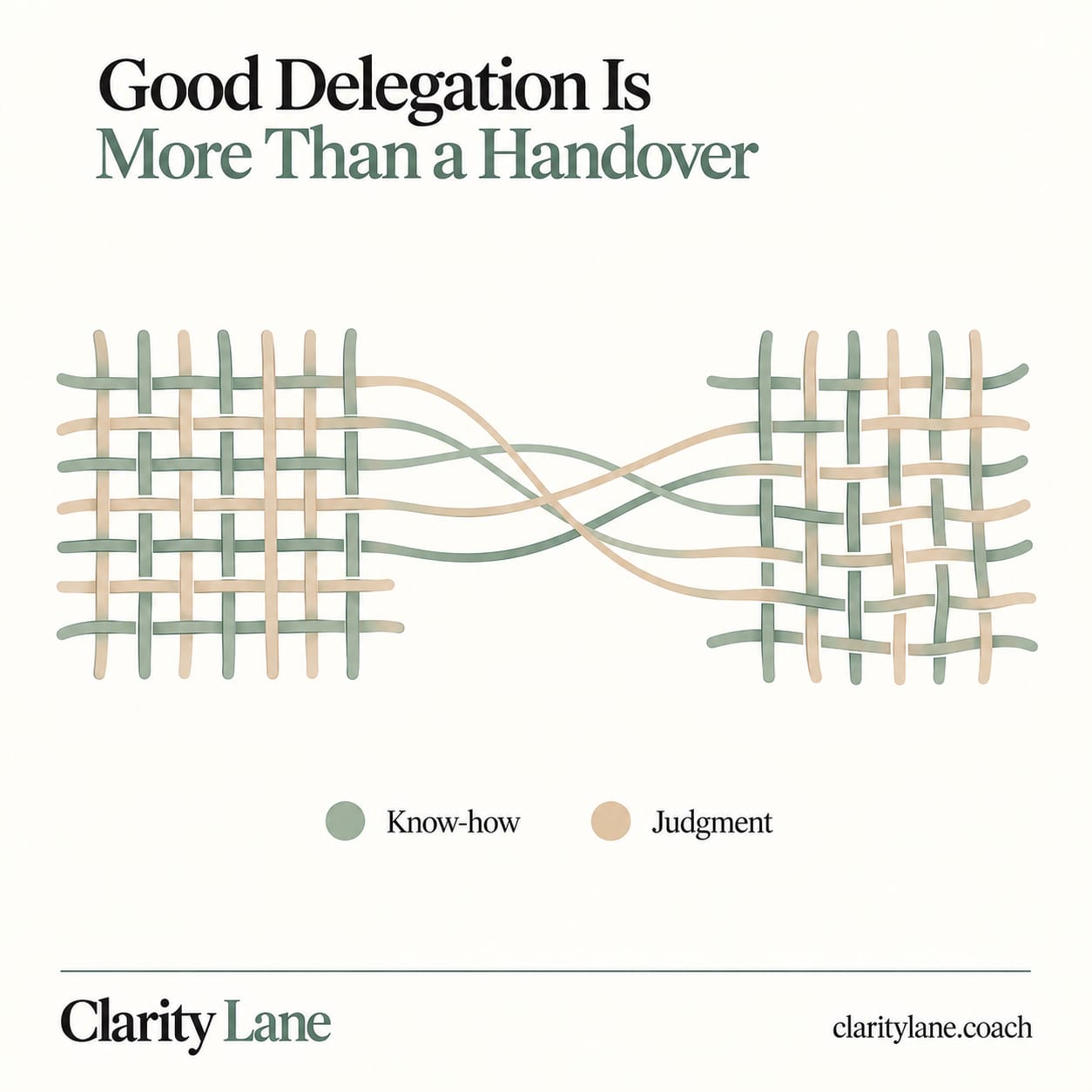
This is where delegation becomes difficult. You are passing on what you do, but the other person also needs to learn what you pay attention to and how you make decisions.
A few questions can make some of that hidden knowledge visible:
What usually goes wrong?
What should I pay particular attention to?
What can I decide myself, and when should I come back to you?
Imagine I ask someone to prepare a presentation.
I tell them what should go on each slide. They prepare it. I review it, change the structure, rewrite several slides and approve every sentence.
The presentation has been delegated. The judgment behind it has not.
Next time, the person may still need me to decide what matters, how to structure it and whether the result is good enough.
I could approach the same task differently.
The first time, I might explain what the presentation needs to achieve, who will see it and what I look for in a good result. We could agree on a few criteria together.
When the person comes back with a draft, instead of immediately correcting it, I can ask:
What do you think of it?
Does it achieve what we agreed?
What would you improve?
The next time, I might give less guidance. The person can use the same criteria to review the presentation before bringing it to me.
Later, I may only need to see the final result.
Eventually, perhaps I do not need to review it at all.
The task has not changed. What has changed is where the judgment sits.
How quickly this can happen depends on the task and the risk involved. Some decisions can be handed over quite quickly. Others will always require closer review.
A useful test is what happens the next time the task comes around.
Does the person need the same instructions again?
Do they still need you to tell them what is good enough?
Or are they starting to notice problems, question their own work and make sound decisions themselves?
That is when delegation starts to work.
You have not simply transferred the work.
You have transferred some of the judgment that used to sit with you.
If this reflection resonates, coaching can give you a calm space to clarify what comes next.
Book an introductory call